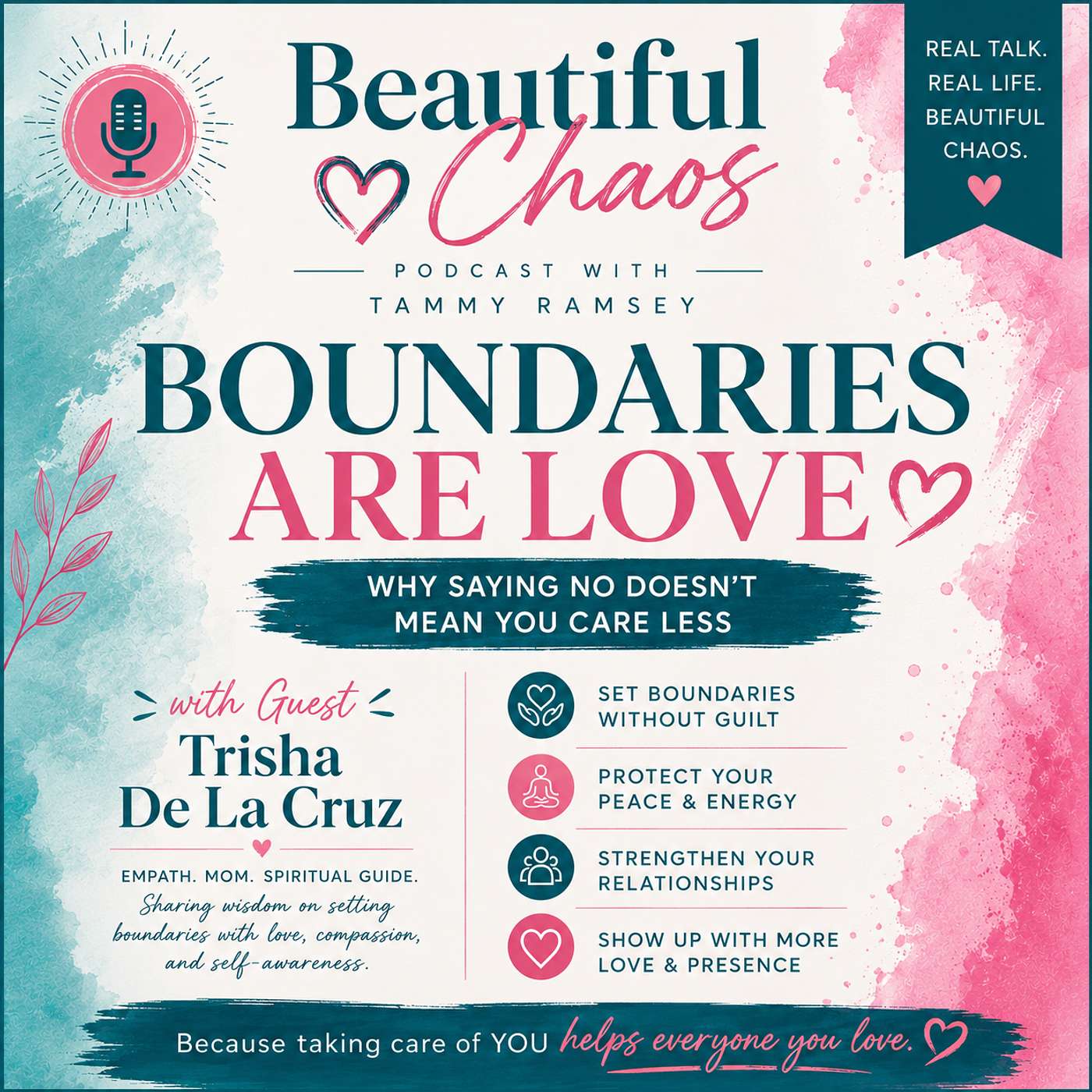
Boundaries Are Love
Have you ever said yes when you really wanted to say no?
Many of us struggle with setting boundaries because we’re afraid of disappointing people we love. But what if healthy boundaries aren’t selfish at all? What if they’re actually one of the most loving gifts we can give ourselves and others?
In this episode of Beautiful Chaos, Tammy Ramsey sits down with friend, mother, empath, and spiritual guide Trisha Delacruz to explore the power of healthy boundaries. Together they discuss why empaths often struggle with overgiving, how boundaries protect our peace, and why saying “no” doesn’t mean you care less—it often means you care enough to show up as your best self.
Whether you’re feeling overwhelmed, stretched too thin, or simply learning to put your own oxygen mask on first, this conversation offers practical wisdom and encouragement for creating healthier relationships and a healthier life.
✨ In this episode:
• Why boundaries are not selfish
• The difference between boundaries and walls
• Why empaths struggle with saying no
• How boundaries reduce resentment
• Practical ways to set healthy boundaries
• Why protecting your peace benefits everyone around you
💬 We’d love to hear from you:
What’s one boundary you’ve set that changed your life—or one boundary you know you need to set right now?
Subscribe for more conversations about personal growth, health, relationships, faith, and finding beauty in life’s chaos.
#BeautifulChaosPodcast #BoundariesAreLove #HealthyBoundaries #PersonalGrowth #SelfAwareness #MentalWellness #HealthyRelationships #EmpathLife #SelfCare #JoyOfAging #AgingWithJoy
Thank you to our Sponsor Seranova.com! Seranova has a great Micro Infusion System that dimities the appearance of wrinkles & sagging skin in 8-12 weeks. This is an easy to use at home application to reveal younger and more even-looking skin. There is even a money back guarantee! It also helps fade the appearance of dark spots and is recommended by dermatologists. If you would like to try this amazing product, which Tammy give's a thumbs up, then go to http://www.seranova.com
YouTube: @beautiful Chaos Tammy
Facebook: Beautiful Chaos
SPEAKER_02: Have you ever said yes when every part of you wanted to say no?
SPEAKER_02: I mean, maybe you've taken on one more responsibility or volunteered, you and I are both involved in these things.
SPEAKER_02: Volunteered for one or more projects, or cared for everyone around you while completely neglecting yourself.
SPEAKER_02: Today we're talking about boundaries and why they aren't selfish at all.
SPEAKER_02: In fact, healthy boundaries may be one of the most giving, loving gifts we give ourselves and the people we care about.
SPEAKER_02: Joining me today is my friend Trisha Delacruz.
unknown: Hi.
SPEAKER_03: Hi.
SPEAKER_02: As an empath mother and someone who has learned the power of healthy boundaries, she's sharing practical wisdom on how saying no doesn't mean you care less.
SPEAKER_02: It often means you care enough to show up as your best self.
SPEAKER_02: So yes, for sure.
SPEAKER_02: Let's dive in.
SPEAKER_00: It's a beautiful chaos.
SPEAKER_00: It's a beautiful chaos.
SPEAKER_00: Sometimes sometimes we're shaking.
SPEAKER_00: This beautiful chaos.
SPEAKER_02: Welcome to Beautiful Chaos.
SPEAKER_02: And this episode is Boundaries Are Love.
SPEAKER_02: And I'm so grateful that you are jumping on this podcast today.
SPEAKER_02: Um I I've I've witnessed you uh setting boundaries, and I've always respected how you handle things.
SPEAKER_02: And I believe we've had conversations about this before.
SPEAKER_02: Yes.
SPEAKER_02: Many conversations.
SPEAKER_02: So let's start off with how you define boundaries.
SPEAKER_02: We talked about what a um well, I guess maybe it's not how do you define boundaries.
SPEAKER_01: It's how do you why about how you define when you need them?
SPEAKER_01: Yes.
SPEAKER_01: Okay.
SPEAKER_01: How about that?
SPEAKER_01: Let's start with that.
SPEAKER_01: Boundaries need to appear once you feel like you're uncomfortable being around something, doing something.
SPEAKER_01: Like that's when you want to start creating boundaries.
SPEAKER_01: For example, if you are sitting around a bunch of people, if you're sitting around people that you are uncomfortable with, okay?
SPEAKER_01: Right.
SPEAKER_01: Creating those boundaries would be not telling those people, hey, I'm uncomfortable with you guys.
SPEAKER_02: It's trying to control yourself because you can't control them, but you can control how you're viewing the situation, and you're gonna either take yourself out of the situation.
SPEAKER_02: Would that be setting a boundary?
SPEAKER_01: Or what would you do with that?
SPEAKER_01: It would be because putting yourself in that scenario, okay?
SPEAKER_01: So say you are with a bunch of people and you have some people who are just sometimes they're just rude, right?
SPEAKER_01: Right.
SPEAKER_01: And so they're just being negative, you don't want to be in the energy, saying, Hey friend, I don't want to be around you because you're always so negative.
SPEAKER_01: That's going to escalate.
SPEAKER_01: Right.
SPEAKER_01: That's going to turn into something that you don't really want to deal with, right?
SPEAKER_01: Right.
SPEAKER_01: They're going to get defensive.
SPEAKER_01: Yep.
SPEAKER_01: And then you're going to become defensive because they're defensive, because you just feel like you're expressing that boundary.
SPEAKER_01: Right.
SPEAKER_01: Which in actual reality, you want to create the boundary for yourself.
SPEAKER_03: Right.
SPEAKER_01: So there are two different ways to handle this.
SPEAKER_01: Say the next time the friend comes over.
SPEAKER_01: I love that you are going to come over.
SPEAKER_01: However, let's keep conversations here.
SPEAKER_01: That's setting a boundary.
SPEAKER_01: We are going to keep the energy positive, and that's what you're coming into.
SPEAKER_01: So you're setting that boundary by explaining it in the very beginning without shutting anybody down right away.
SPEAKER_03: Right.
SPEAKER_01: You're just, you know, letting them setting that boundary.
SPEAKER_01: Or you can walk away.
SPEAKER_01: Right.
SPEAKER_02: So giving them a guideline.
SPEAKER_02: Yeah, I had someone in my life that I had to set a boundary with.
SPEAKER_02: And when I but I I made the mistake of saying, okay, I I need you to not um tease me continually and talk negatively about my weight, my looks, like all these things.
SPEAKER_02: And this person said, well, and I'd said, well, my counselor said, I need to do this, I need to set this boundary.
SPEAKER_02: And I'm very open and thought I was doing the right thing by saying, I need you to, you know, be respectful of me in a sense.
SPEAKER_02: And this person said, Well, your counselor didn't mean me, because I'm the one that keeps you level-headed.
SPEAKER_02: Uh-oh.
SPEAKER_02: And that was a person that I had to be like, okay.
SPEAKER_02: So I guess I just have to exit the relationship and just keep you at arm's length.
SPEAKER_02: Yeah.
SPEAKER_02: That yes.
SPEAKER_02: Minimal exposure.
SPEAKER_01: Yep.
SPEAKER_01: And that is that is setting that boundary.
SPEAKER_01: Right.
SPEAKER_02: So yes.
SPEAKER_02: I like that.
SPEAKER_02: And so what's the difference between a boundary and a wall?
SPEAKER_02: Because I think like sometimes I'm always nervous about setting a boundary because I'm like, well, I don't want to hurt the other people's feelings, or I don't want them to feel like I just put up this this wall on you.
SPEAKER_01: Right.
SPEAKER_01: You know?
SPEAKER_01: Yeah.
SPEAKER_01: So a boundary is more like a fence versus a wall is more like a straight shutdown, right?
SPEAKER_01: Right.
SPEAKER_01: So if you're going to put up a wall with somebody, there's no entrance, right?
SPEAKER_01: There's nothing, you can't see through walls, right?
SPEAKER_01: Right.
SPEAKER_01: But a boundary is more like a fence.
SPEAKER_01: They can still see through, they just can't quite get to you.
SPEAKER_01: Right.
SPEAKER_01: With you know, you stop them before they get there.
SPEAKER_01: Right.
SPEAKER_01: So that's what I would say the difference between a boundary and a wall is is a boundary is more like a fence.
SPEAKER_01: And you're still allowing these people in, but you're not fully allowing them in.
SPEAKER_01: There's a fence saying, hey, you can peek through or you can come in, all these other aspects of life.
SPEAKER_01: However, there are fences on these certain things right here.
SPEAKER_02: Right.
SPEAKER_02: There's a little bit of guidelines.
SPEAKER_02: Which I think it like falls into a lot of the um understanding of you you can't have expectations of other people.
SPEAKER_02: No.
SPEAKER_02: If you don't let them know what you're what you're what you're what you're thinking in your mind, in a sense.
SPEAKER_01: Very much so.
SPEAKER_01: Expectations are an automatic killer.
SPEAKER_01: You should never have expectations on anyone or anything except for yourself.
SPEAKER_01: And that rolls back into having that, you know, self-care, self-boundaries.
SPEAKER_01: Because when you lay expectations on other people, you should expect to be let down.
SPEAKER_02: Yeah.
SPEAKER_02: Well, 100%.
SPEAKER_02: Well, and the same with so there's a Buddha thing that says, you know, um, because I read this book that was Buddhism without the religion.
SPEAKER_02: Yeah.
SPEAKER_02: And it was like, um expectations are so bad, even in your own life.
SPEAKER_02: Like it and I think it the point was it's okay to have your goals, right?
SPEAKER_02: But don't have an expectation that you're going to I don't know, succeed within a certain amount of time.
SPEAKER_02: Exactly.
SPEAKER_02: There can't be a time on it.
SPEAKER_02: There can't be a label.
SPEAKER_02: I mean, certainly you can hope to be successful in whatever you do, but you need to um appreciate the the journey.
SPEAKER_01: Oh, yeah.
SPEAKER_01: Definitely be lenient with the journey because you know, you're always you're gonna be up, you're gonna be down, you're gonna, it's gonna be easy, it's gonna be hard.
SPEAKER_01: Yeah, you know, you're gonna go through the ups and downs.
SPEAKER_02: So yeah.
SPEAKER_02: So let's talk about because when I introduced you, I introduced you as an empath, which I believe I am as well.
SPEAKER_02: Absolutely.
SPEAKER_02: And I have always struggled with and knew or figured out um when my kids were younger in the teenage years, I realized that I was an empath because I kept they would one of them would be upset, and all of a sudden I would be upset.
SPEAKER_02: Oh yes, absorbing their energy.
SPEAKER_02: And then I was so confused because I'm like, okay, prior to you know, spending time with this child or discussing this small thing, but at teenagers, when you know, man, when you got hormones going on, teenagers are like an explosive device.
SPEAKER_02: I feel emotional ones.
SPEAKER_02: I'm just entering that feel for you.
SPEAKER_02: It is coming, but it is that like I I you just I don't know.
SPEAKER_02: I was told once to put on a rubber suit, and I think you and you and I have talked about this because you don't do a rubber suit, but there's something that you An energy bubble.
SPEAKER_01: Yes, I protect myself with that.
SPEAKER_01: So it's I do this in the mornings when I get up and I meditate.
SPEAKER_01: Um before when I meditate, I kinda I just sit and I imagine that I have a protection bubble around me, and it's just a light that keeps anybody else's energy from me.
SPEAKER_01: Right.
SPEAKER_01: I do also wear crystals that I do believe, you know, help keep away negative energy and things like that.
SPEAKER_01: So I protect myself in a few different ways.
SPEAKER_01: Yeah.
SPEAKER_01: And I think that's this is also falls into the boundaries though.
SPEAKER_01: Yes.
SPEAKER_01: Because this is also where an empath should protect themselves, right?
SPEAKER_01: Because absorbing so many people's energy and especially all at once, listen, it will put you in bed for a week sometimes, right?
SPEAKER_01: Because it's just so much.
SPEAKER_01: But being able to recognize, hey, I'm an I know I'm an empath already.
SPEAKER_01: This energy does not feel right, right.
SPEAKER_01: Being able to recognize that and say, okay, I'm out.
SPEAKER_01: Like, I know that this isn't right for me, it doesn't feel good, and you leave.
SPEAKER_03: Yeah.
SPEAKER_01: But that's creating that boundary.
SPEAKER_02: Right.
SPEAKER_02: And that's a good one.
SPEAKER_02: Well, and I think the other thing is is to take time and recognize that like for instance, I was on the phone call with a friend and they were going through a divorce and all these things, and and man, I got off the phone and and I was just, whoa, I was sad.
SPEAKER_02: I was like ready to cry.
SPEAKER_02: Feel like all the feeling all the fuel.
SPEAKER_02: And then I then I had to do the stop and go, wait a minute, pull your emotions.
SPEAKER_02: I need to release this energy because that is not mine, and go back to prior to this phone call, I was happy.
SPEAKER_01: Yep, good, and but see, you recognized it.
SPEAKER_01: Yeah, I think that's that is a huge thing, right there.
SPEAKER_01: Is being an empath, you've got to recognize that hey, these are not my emotions, these are not my feelings.
SPEAKER_01: Right.
SPEAKER_01: As an empath, we absorb these feelings and these emotions so it's easier for us to connect with others because I mean we're all here to help, you know, and so each other, encourage each other and connect, you know, and so I feel like we're lights.
SPEAKER_02: Like I've always thought of myself as like just kind of a light.
SPEAKER_02: I want to be that uplifting, you see my face and you want to smile.
SPEAKER_02: Yeah, and that's the way you are.
SPEAKER_02: I see your face and you're smiling all the time.
SPEAKER_02: It's it's good to good to be around.
SPEAKER_02: So um, what are some signs that tell you your boundaries need attention that maybe you're not honoring your own boundaries?
SPEAKER_01: Well, you'll feel it.
SPEAKER_01: Honestly, you feel it.
SPEAKER_01: You'll feel uncomfortable, like you'll go home.
SPEAKER_01: Your mind is exhausted.
SPEAKER_01: Yep, you'll go home and you'll feel like or you just exhausted, uncomfortable, and you'll lay down.
SPEAKER_01: And if you, you know, I'm as an empath, you're really usually in your head a lot.
SPEAKER_03: Yes.
SPEAKER_01: Right?
SPEAKER_01: You think a lot, you think about everything it just doesn't stop.
SPEAKER_01: So you'll know because your body's gonna tell you, your soul's gonna tell you, everything about you is gonna tell you.
SPEAKER_01: So when you go to lay down and rest that night, if you should be creating boundaries and you did not, you're gonna feel it.
SPEAKER_03: Right.
SPEAKER_01: And you're gonna repeat that same scenario where you should have set that boundary, where you should have walked out of that room, where you should have said, Hey, this is too much for me.
SPEAKER_01: I need to go.
SPEAKER_02: Yeah.
SPEAKER_01: Yeah.
SPEAKER_01: And so that's that's where you're gonna discover that right there is even if you're just washing dishes and in your head washing dishes, because I get in my head washing dishes sometimes.
SPEAKER_01: Oh, yeah.
SPEAKER_01: And then I'm like, oh, I should have said that.
SPEAKER_01: Oh, I should have done that, and I didn't.
SPEAKER_01: You should have just walked away.
SPEAKER_01: Why did you do that?
SPEAKER_02: You know?
SPEAKER_02: I don't know.
SPEAKER_02: Hey, I'm gonna tell you, washing dishes the only place that my mind shuts down.
SPEAKER_02: That or cleaning house.
SPEAKER_02: If I'm cleaning, I got nothing going on.
SPEAKER_02: But oh my gosh, I wish I'm doing laundry or doing projects, all of a sudden, like all these things keep trying to infiltrate my brain, and I'm like, just go away.
SPEAKER_02: So I want to share that um you'll be proud of me that I set a boundary.
SPEAKER_02: So um it it was a it was a scary for me one.
SPEAKER_02: But I'd had my grandkids, I had the three, my three grandboys for about four or five days.
SPEAKER_02: And um, and and Ashley or Ashley and her family, that and they'd all stayed Friday through Sunday, and then I kept the kids until Friday.
SPEAKER_02: And I and then with that comes, okay, the cousins want to come hang out.
SPEAKER_02: So now I got, you know, four other kids.
SPEAKER_02: Well, three other kids, and then I had a bonus kid.
SPEAKER_02: So he calls me grandma too, so that's okay.
SPEAKER_02: So I end up with seven, right?
SPEAKER_02: I end up with seven, seven kids.
SPEAKER_02: Oh, you sound like my house.
SPEAKER_02: It was crazy.
SPEAKER_02: It's a lot of energy, it's a lot of like uh different personalities, different personalities.
SPEAKER_02: You're navigating, and they these guys all get along really great, but they're constantly coming in, getting snacks, and I'm having to, you know, monitor the snack situation and what's going out the door, if anything.
SPEAKER_02: And because I'm kind of I'm a stickler for, you know, I don't mind if you take something out as long as you bring it back.
SPEAKER_02: Yes.
SPEAKER_02: And so when there's a big crowd, I can't keep track of what's happening.
SPEAKER_02: Right, right.
SPEAKER_02: So I'm like, no, no, we're gonna sit at the table and we're not doing all that.
SPEAKER_02: Yeah, we're just gonna.
SPEAKER_02: So, anyways, and then the other thing is so I'm 60.
SPEAKER_02: I say this a lot on the show.
SPEAKER_02: Oh, you're my own.
SPEAKER_02: Beautiful.
SPEAKER_01: Oh my gosh, I hope.
SPEAKER_01: And Ray, I look as wonderful as you.
SPEAKER_02: But unless you're the age of our oldest daughter.
SPEAKER_02: 39, almost 40.
SPEAKER_02: Yes.
SPEAKER_02: So, so there's an age difference, but yet we just really are a lot similar.
SPEAKER_02: But you'll get this one day.
SPEAKER_02: So I no longer cook three meals a day normally.
SPEAKER_02: Kevin and I will cook like a big match of, I'm sorry, but she's vegetarian.
SPEAKER_02: I'm I and she doesn't want to kill a fly.
SPEAKER_02: And I ate meat, I'm a carnivore.
SPEAKER_02: She accepts me and loves me for the way I am.
SPEAKER_02: I definitely do.
SPEAKER_02: Yeah, but when those kids were here, I was not carnivore.
SPEAKER_02: I was just like, I was in survival mode.
SPEAKER_02: Because for one, it's like I'm not used to two wine meals a day and three snacks, and the dishes are never done.
SPEAKER_02: Never done, and there's constantness.
SPEAKER_02: I know, everybody getting into something.
SPEAKER_02: Yeah.
SPEAKER_02: And I mean, I love it, but but but when Friday hit, yeah, I was so exhausted that when when Ashley and them showed up, we all went camping.
SPEAKER_02: Oh, yeah.
SPEAKER_02: And when we we we had a family thing for my for my sister-in-law's uh birthday.
SPEAKER_02: But, anyways, as soon as my those guys showed up, I was like, here's your children.
SPEAKER_02: And it was four o'clock, and I'm like, I have to go to and I literally just couldn't open my eyes.
SPEAKER_02: And I went and I slept for off and on, like I there was interruptions, and finally I got up and locked the camper.
SPEAKER_02: Okay.
SPEAKER_02: And then and then I went to sleep, and I so basically I I lay down at four.
SPEAKER_02: I woke up at quarter till nine.
SPEAKER_02: Oh, and I'm like, well, I'm just gonna get my jammies on and go to bed.
SPEAKER_02: Might as well not even go out and say hi to anybody.
SPEAKER_02: So I get ready and I go climb into bed.
SPEAKER_02: Well, I didn't realize I'd locked Kevin out because he's not.
SPEAKER_02: Sorry, but anyways, we had it was a keycode.
SPEAKER_02: I thought he could get in, but you know, you learn something new every day.
SPEAKER_02: Anyways, so my story of this is so over that weekend, the kids would come to me and say, you know, can we have this or that?
SPEAKER_02: And I would be like, Oh yeah, I'm off duty.
SPEAKER_02: Ask your parents.
SPEAKER_02: You go ask your parents, I'm out.
SPEAKER_02: And then when uh the next week came, like normally I try to do one day a week where I spend with the kids and I do a grandma's day, whether it's just I love that.
SPEAKER_01: I try to do this with my kids too.
SPEAKER_01: It's a this is a very healthy thing to do.
SPEAKER_02: It is, it is hard to keep to a routine, but uh we do better in the summer normally, but but this started off like I pretty much had my grandma day for you know five days.
SPEAKER_02: So then I said I had to call and say, Hey, I'm I cannot do grandma day because I had all this time and I need to recover.
SPEAKER_02: Oh, I needed a me week.
SPEAKER_02: Like you get 60, and it's like it's not a day looking to recover.
SPEAKER_02: It's a week.
SPEAKER_01: But look at you, you set that healthy boundary.
SPEAKER_01: Yeah, they the next week when it came up, you knew you had exhausted everything you you gave everything in a positive mode.
SPEAKER_01: Yeah, you did not over exert yourself, and this is another reason why boundaries are so important because when you created that boundary, not only did you do good for you, you did good for the other people.
SPEAKER_01: And I say this because when you oh you don't set those boundaries and you over-exert yourself, you become not yourself.
SPEAKER_01: Yes, because you're then you do, you're then not giving yourself enough self-love to set that boundary and overexhausting yourself.
SPEAKER_01: So the fact that you were able to say, hey, this week I know I cannot do it.
SPEAKER_01: Nothing this week, you that's good for you, and it's good for everybody else.
SPEAKER_01: So that was amazing.
SPEAKER_01: Because those kids wouldn't have wanted to be around me because I would have had a short temper and I would have been not the fun girl.
SPEAKER_01: And then you would have felt bad about it.
SPEAKER_01: Yeah, especially.
SPEAKER_01: And so don't make yourself feel bad either.
SPEAKER_01: I mean, this is a win-win.
SPEAKER_01: The boundaries are a win-win situation.
SPEAKER_01: Yeah, 100%.
SPEAKER_02: Yes, 100%.
SPEAKER_02: And I'm I'm seeing the good results for that.
SPEAKER_02: Because your fear, I think, when you set a boundary is oh, they're gonna upset somebody, they're gonna hate me, they're never gonna wanna, oh, and yeah, you're having this internal conflict and judging yourself harshly because you're just sure that's what's gonna happen.
SPEAKER_02: And then guess what?
SPEAKER_02: It doesn't, because they're understanding and they're like, oh no, I get it.
SPEAKER_01: Yeah.
SPEAKER_02: And I'm like, okay.
SPEAKER_02: Yep, 100%.
SPEAKER_02: Yeah.
SPEAKER_02: So, and and that was a good lead into what do you practice as a mom with your own kids as a way to set boundaries?
SPEAKER_02: Like, do you set boundaries between you and your kids?
SPEAKER_01: Oh, absolutely.
SPEAKER_01: Yeah, for sure.
SPEAKER_01: Um, we boundaries, rules, yes, we have all of these in our house.
SPEAKER_01: Um, for example, one of our biggest boundaries, because I care so much about them, they care so much about me, I care so much about their relationship, and I want them to care about their relationship with one another too, Chase and Sabrina.
SPEAKER_01: And so um one of a few of our boundaries that I have so that we ensure those relationships never, I mean, they're gonna get toxic at some point, right?
SPEAKER_01: Right.
SPEAKER_01: They're gonna have they're they're gonna be at some point.
SPEAKER_01: Yeah, there's growing.
SPEAKER_01: But you know, we don't boundaries I have in my home with my kids is we don't call each other names.
SPEAKER_01: Nobody calls names.
SPEAKER_01: Yeah.
SPEAKER_01: We do not yell or scream.
SPEAKER_01: Yelling and screaming, it just you know, I've done it in the past.
SPEAKER_01: I'm listening I'm guilty of a, you know, probably of a few of these things in um, but setting these boundaries, it just really creates a healthier environment.
SPEAKER_01: Healthier environment.
SPEAKER_01: And so, you know, the no screaming, we don't scream at each other because when you scream at each other, when you yell at each other, it just it blows up.
SPEAKER_01: Yeah, it changes the atmosphere and it changes the feelings.
SPEAKER_01: Like it really does, you know.
SPEAKER_01: Hurt people, hurt people, that's a thing.
SPEAKER_01: Yeah, you know, and so when you're screaming at somebody, you're hurting them intentionally.
SPEAKER_01: They're gonna scream back to hurt you back intentionally, and you go nowhere with this.
SPEAKER_03: Yeah.
SPEAKER_01: So we don't scream at each other.
SPEAKER_01: In fact, when we do get angry, it is a walk away.
SPEAKER_01: Let's go to our space, which is our bedrooms, let's go to our space, and that's what we all do.
SPEAKER_01: And I will walk away.
SPEAKER_01: If my child, if my mainly my daughter, when she's ready to argue, I will be the example and I will say, I love you too much to argue with you.
SPEAKER_01: Yeah.
SPEAKER_01: We're not doing this.
SPEAKER_01: Yeah.
SPEAKER_01: And if she keeps persistent about arguing to get her word out, I I tell her, okay, I need you to go think about a better way we can handle this situation.
SPEAKER_01: I'm going to my room and I will dismiss myself from the conversation.
SPEAKER_02: Gosh, I look back at my raising my girls and I don't know what it is.
SPEAKER_02: It seems like the girls push back against the moms and the boys push back against the dads.
SPEAKER_02: Like it's just, I always I say it's like you can't have two hens in a hen house.
SPEAKER_02: I mean, you really can in chicken world.
SPEAKER_02: But in women world, you can't have two hens in the hen house.
SPEAKER_02: Like, there's gotta be one hen that's like the top little less dominant.
SPEAKER_02: Yeah, you got one that's dominant, and the other one's like, you will mind this big chicken.
SPEAKER_02: And and the same with the roosters.
SPEAKER_02: And and there's that one rooster in the in the rooster house, and that's a true fact.
SPEAKER_02: Oh, yeah.
SPEAKER_02: And then the the younger rooster in real people life wants to knock that big rooster off because he's ready to expand and to grow.
SPEAKER_02: And I think that's what a lot of the pushback is from our our daughters.
SPEAKER_02: But but it anyways, I think that that's that's huge.
SPEAKER_02: And I think it's great that you are being an example of that boundary, of that, it's like a reset.
SPEAKER_02: You're giving yourself, you're giving her an opportunity to reset.
SPEAKER_02: You're both gonna step back, you're gonna calm your uh sympathetic nervous system because that's what's happening.
SPEAKER_02: Yes, and you you could you get all and then you're gonna come back and and try to negotiate.
SPEAKER_02: And most of the time it's probably ends up being nothing because if she has time to calm down, the emotions shut down, and then it's like okay.
SPEAKER_01: Yes.
SPEAKER_01: And then and and then the conversation just usually leads better from there because then we're both because listen, I can't I do get upset too.
SPEAKER_01: Like I'm not always gonna be like so calm and so chill, and it's going on, you know.
SPEAKER_01: I do get upset too.
SPEAKER_01: And so it really is good for us to both separate out.
SPEAKER_01: We do, like you said, we calm that nervous system, we come back, we regroup, and we conversate again about whatever transpired.
SPEAKER_02: Yeah, and I love that.
SPEAKER_02: And I I think that it's important to say that uh no child, I've said it before, no child comes through childhood unscathed.
SPEAKER_02: Yes, you can be the best parent in the entire world, but they're still gonna see something in that happened that's gonna just throw them off.
SPEAKER_02: Absolutely, and and I love that it's like we're not perfect parents.
SPEAKER_02: None of us.
SPEAKER_02: We're all doing this for our first time.
SPEAKER_02: Yeah, I was a first-time stepmom, I was a first-time mom at the same time, pretty much.
SPEAKER_02: Like a you know, a mom for five years, then all of a sudden I became a mom and a stepmom.
SPEAKER_02: Yeah, and then I became a mom of a of a baby after 10 years and no baby.
SPEAKER_02: So, like there's just a lot of and so you have to give some um uh compassion for for your parents for what they do.
SPEAKER_02: Oh, for sure.
SPEAKER_02: Yeah, well, and you know it's not easy raising kids.
SPEAKER_01: It's not, and kids, here's the thing is kids do test boundaries.
SPEAKER_01: Yes, they do that's that is the number one thing that kids really, really do test boundaries.
SPEAKER_01: And whether they're your kids, whether you're they're your kids' friends, you know, it doesn't your nieces, nephews, all kids are going to pet press boundaries.
SPEAKER_01: So if as an adult, if you've already created your boundaries for certain things, then you're automatically teaching these children these boundaries by by example.
SPEAKER_01: By example, yeah.
SPEAKER_02: Yeah, and kids leading by example, kids.
SPEAKER_02: It's learn best by example.
SPEAKER_01: Yeah, yeah.
SPEAKER_02: Well, we all do, like, for sure.
SPEAKER_02: If I sit here and tell you how to behave, then you're gonna be like, well, what is why does she think she's got any knowledge on how I should behave?
SPEAKER_02: I'm telling, I'm sharing with you, like you're sharing.
SPEAKER_02: Hey, these are things that have happened.
SPEAKER_02: Yeah, experience.
SPEAKER_02: We've been in the thick of it, or we're in the thick of it.
SPEAKER_02: You could call me anytime and cry teenage emotions because it's a thing, like it really is.
SPEAKER_02: And I tell you what, when uh uh uh our oldest hit uh 14, I think was the it was really 13 where there was some eye rolling, but 14, it was like, are you ready to pack your bags and go?
SPEAKER_02: Oh my goodness, somebody I think as parents we should set up a support group, and like as soon as your child rolls their eyes, they should go live with someone else for like two months, and you take that person's child because I would notice like in dance, I could I could not do my daughter's hair.
SPEAKER_02: Oh, she would be crying, oh my head, my head.
SPEAKER_01: Oh yeah, but all the other groups.
SPEAKER_02: Oh my gosh, but I could do everybody else.
SPEAKER_02: So Debbie and I would switch.
SPEAKER_02: I would do Sarah's hair, and she never fussed at all, and Sarah and Debbie would do Ashley's hair, and everybody was happy.
SPEAKER_02: So that's what gave me the idea of Debbie's need to switch kids for a while.
SPEAKER_02: Get them out of that, you know?
SPEAKER_02: Yeah.
SPEAKER_02: Like, you don't have to push against me.
SPEAKER_02: I will lift you.
SPEAKER_02: I will lift you every day that you want to be lifted, but you don't have to push, push at me.
SPEAKER_02: So, so let's go back to the boundaries because that's really what we're talking about.
SPEAKER_02: Sorry, off track.
SPEAKER_02: This is normal for us.
SPEAKER_02: Yes, totally normal.
SPEAKER_02: We squirrel all the time, all the time.
SPEAKER_02: So I think that um it's important to take time to rest.
SPEAKER_02: For sure.
SPEAKER_02: Because, like when you were talking about even exposing yourself to those energies that might not align with your energy and it feels heavy.
SPEAKER_02: Yes.
SPEAKER_02: It's it does just wipe you out.
SPEAKER_02: It does, absolutely.
SPEAKER_02: Yeah, and people tend to um want to just unload all their woes.
SPEAKER_02: Oh yeah, everywhere.
SPEAKER_01: I I meet strangers.
SPEAKER_02: Oh yeah, me too.
SPEAKER_02: Like talking to somebody at a grocery line, and man, I know more than I I expected to.
SPEAKER_02: Oh yeah.
SPEAKER_01: Oh yeah.
SPEAKER_02: And I'm appreciative for the connection, but sometimes you do walk away and you're like, you know what, I just need an hour and a half after that conversation because that was a lot.
SPEAKER_01: Yep.
SPEAKER_01: Um well, and you know, something with that is breathe it off.
SPEAKER_01: There, you know, breath work is a huge thing too.
SPEAKER_01: Yeah.
SPEAKER_01: And so sometimes when I get back in my car, because this does happen to me very frequently.
SPEAKER_01: Yeah.
SPEAKER_01: And um sometimes when I get back into my car and I do feel like maybe I did absorb some of their energy and I don't want it, I will take myself back to the this is not my energy.
SPEAKER_01: And I will sit in my car, deep breaths, breathe it in, breathe it out, and just really wipe it away.
SPEAKER_03: Yeah.
SPEAKER_01: Like a reset.
SPEAKER_02: A reset.
SPEAKER_02: I do believe in deep breathing and uh for I get anxious sometimes, and I think it is just because of like all the energy that I'm trying to and and I'm holding it tightly instead of going, wait, just release this and release it, yeah.
SPEAKER_02: Yeah, and so I'll do breathing, and now I've added uh shifting my eyes up to the right and down to the left, up to the right, down to the left, and I just do that multiple times, and then all of a sudden it's like everything releases so much faster.
SPEAKER_02: Yeah, it's almost like the tapping, yes, on the meditation and you tap and you're like, wow, that just totally cleared my head.
SPEAKER_02: And all those thoughts that were going on, women, we spin out of control.
SPEAKER_02: And I'm gonna tell you right now, and I'm sad to say it doesn't go away.
SPEAKER_02: I was just talking to a whole bunch of women that it was like, why?
SPEAKER_02: Why are we all this way?
SPEAKER_02: And I go, man, I thought I had ADHD, but I probably I do have ADHD.
SPEAKER_01: I do too.
SPEAKER_01: I I definitely do too.
SPEAKER_01: But then do I think here's the thing is it's not always a negative thing.
SPEAKER_01: Here, you know, it's actually it's almost a superpower, if you ask me.
SPEAKER_01: Yeah.
SPEAKER_01: Because to be able to think about things in so many different scenarios in so many different ways, like ways, you actually like it is an asset because you're prepared for whatever comes your way.
SPEAKER_01: Yeah.
SPEAKER_01: Think about how hard things are when you're not even kind of prepared.
SPEAKER_01: Yeah.
SPEAKER_01: You know what I mean?
SPEAKER_01: And so if you when you do go off like that as a woman, and I but I do think that we have men who are overthinkers too.
SPEAKER_01: I do think it's oh yeah, both you know, personality thing.
SPEAKER_01: Yeah, and so I think that you know, just getting yourself back into where you were previously, yeah.
SPEAKER_02: Through the breathing, through the resetting your your thing.
SPEAKER_02: Okay, so we're gonna take a really quick break uh and give you some info on our sponsors, which is one reason why I don't have makeup on today, is because I did a micro abrasion treatment yesterday, and you have to go 24 hours without makeup.
SPEAKER_02: So I did put on a little eyeshadow and mascara, but here's the full face.
SPEAKER_02: So here's to Seranova.
SPEAKER_02: This episode of Beautiful Chaos is brought to you by Sara Nova.
SPEAKER_02: They have a micro needling infusion kit that I've been using for eight weeks now, and I can tell you my skin is looking smoother.
SPEAKER_02: My little saddlebags I had forming on my jawline are tightening up.
SPEAKER_02: It's been amazing.
SPEAKER_02: So if you guys want to try Sera Nova, you can do this in your own home.
SPEAKER_02: It's very easy to use.
SPEAKER_02: They even offer a refund policy.
SPEAKER_02: So it gives you a little more courage to try something new.
SPEAKER_02: But I have really enjoyed it.
SPEAKER_02: And if you want to try it, because I absolutely love it and feel like it's actually working on my skin, you can go to saranova.com, put in my code Tammy in all caps t-a-m-m-y 01873.
SPEAKER_02: Your micro needling infusion kit is waiting for you.
SPEAKER_02: I want to talk about boundaries and how they can improve relationships because I d I do think it's really easy if if if you don't, if you're not healthy enough to recognize that you need to set boundaries and you just keep loading your plate and loading your plate, and maybe one person just keeps um overtaking your plate in a sense, or you um you you have one person you feel like you're doing more for, you can start to resent that person because you're feeling overwhelmed because you didn't set a boundary.
SPEAKER_02: It's like an overgiver syndrome or people pleaser.
SPEAKER_01: People pleasing, that's that really is.
SPEAKER_01: This is so people pleasing is it's one of the biggest reasons people don't set boundaries because they do feel that guilt.
SPEAKER_01: And in a relationship, whichever relationship it is, right?
SPEAKER_01: Yeah, any of them, it's it's that worry that when you do set that boundary, they're gonna be angry with you.
SPEAKER_01: They're gonna, they're gonna be upset with you, they're going to lash back at you.
SPEAKER_01: You know, it is that fear, but having these boundaries in all of these relationships, you know, uh creates a stronger foundation.
SPEAKER_01: It creates a stronger relationship.
SPEAKER_01: Um create I think the hardest people or the hardest thing for people to do is to communicate about the boundaries that needs to be set.
SPEAKER_01: Yes.
SPEAKER_01: The communication part of fear.
SPEAKER_01: Yes.
SPEAKER_01: The communication part I think is where it's the hardest because you know, sometimes where per people are so different and perceptions are so different, you can say one thing one way and it can be completely taken another way.
SPEAKER_01: That's a different personality.
SPEAKER_01: So it is, it is, and so one huge boundary that um I have, for example, in like relationships is whenever there's anything heated going on between you know, me or somebody else, whoever I'm on the phone with, it is to never happen over a text message.
SPEAKER_01: Oh you know, and recently I was actually re-reminded of why.
SPEAKER_01: Because you know what I'm talking about.
SPEAKER_02: Because you forgot and you did the text message thing.
SPEAKER_02: It's funny how we have vehicles.
SPEAKER_01: Yeah, like it didn't even take, it didn't even take a couple of hours.
SPEAKER_01: It literally took an overnight thing to just turn around and bite me because I should not have had a heated conversation over a text message.
SPEAKER_01: There they were taken, you know, all these words, all this situation was taken completely wrong, twisted inside out, and there was nothing but hurt people.
SPEAKER_01: Yeah.
SPEAKER_01: And and because I broke my own boundary.
SPEAKER_01: Yes.
SPEAKER_01: And so trust me, we're back on that boundary.
SPEAKER_02: Oh, it's important.
SPEAKER_02: It's important to stick with those boundaries.
SPEAKER_02: Very, very much so.
SPEAKER_02: And it but it's and it's also okay to give ourselves grace and go.
SPEAKER_02: You know what?
SPEAKER_02: I don't get it right all the time.
SPEAKER_02: And I forget, I forget that I have the toolbox with the tools.
SPEAKER_02: Yes.
SPEAKER_02: Because I haven't had to use them for so long.
SPEAKER_02: Yeah.
SPEAKER_02: I've been good about, you know, keeping that boundary.
SPEAKER_02: Yeah and then it just it's it's that moment.
SPEAKER_02: It is.
SPEAKER_02: You forget.
SPEAKER_02: Yes.
SPEAKER_02: It's like, dang it.
SPEAKER_02: You need to get that toolbox out of the trunk.
SPEAKER_02: I've been sitting back there way too long.
SPEAKER_02: That's why my trunk's a little bigger than the rest of them.
SPEAKER_02: My toolbox is large.
SPEAKER_02: Um so if no one has set boundaries before, where should they start?
SPEAKER_01: What's an easy um well, if you've never first recognition is huge.
SPEAKER_01: Recognize where the boundary needs to be set, and then start catching it.
SPEAKER_01: And what's it?
SPEAKER_01: Every time you're feeling exhausted from a situation.
SPEAKER_01: Yep, that feeling of oh, regret is almost a feeling of regret, you know.
SPEAKER_02: Yeah.
SPEAKER_01: Saying yes to something that you really f wanted to say no to.
SPEAKER_01: And you feel that heaviness.
SPEAKER_01: Yep.
SPEAKER_01: And so really setting those boundaries, you know, with you and your self-care is huge.
SPEAKER_03: Yeah.
SPEAKER_01: So and it's a part of everything that you do every day.
SPEAKER_01: You know, self-care is saying no.
SPEAKER_01: That is a boundary.
SPEAKER_03: Yeah.
SPEAKER_01: You know, it is saying, I really don't feel good today.
SPEAKER_01: I know I have prior examples or prior situations I have to take care of.
SPEAKER_02: I know I've got to do things, but But I gotta take a me moment or a me day.
SPEAKER_02: Yes.
SPEAKER_02: Sometimes uh my daughter-in-law is really wise for her young age.
SPEAKER_02: Uh, she's like 26, but um, one day I was like having I was telling her I'm having a meltdown.
SPEAKER_02: I've just been overloaded and overwhelmed, and it's time to just have a meltdown.
SPEAKER_02: And she's like, Well, get in your jammies and put on your favorite movie and crawl into bed and just be.
SPEAKER_02: And I was like, Yep, yeah, yeah.
SPEAKER_02: That's like totally it.
SPEAKER_02: So I mean, that's something you could do to try to recover, but um, one thing that you guys can do as listeners is to just pick somewhere in your life where you feel like you have to set a boundary and and practice it this week.
SPEAKER_02: And everything in life is a practice because we we could get it right over and over and over again, and then just in one instant not get it right, and that's okay, because that's what everything in life is is a practice, right?
SPEAKER_01: It's learning.
SPEAKER_01: Like, here's the thing is everything in life is about learning, it is about becoming a better version of yourself.
SPEAKER_01: Yes, and not comparing yourself to anybody else.
SPEAKER_02: No, no, no, no.
SPEAKER_01: You know, and that should be a big thing.
SPEAKER_02: Comparing yourself to yeah, comparing yourself to you from yesterday.
SPEAKER_02: Yes, yes is a good one.
SPEAKER_01: It I think we deal with that a lot, though, actually.
SPEAKER_01: I think a lot of people are always in that comparison stage.
SPEAKER_01: And you know, one healthy, huge, healthy boundary to set for yourself is only to compare yourself from your past self.
SPEAKER_01: That's the only person you should ever compare yourself with.
SPEAKER_01: Yeah.
SPEAKER_01: Because nobody's lived your life, you have not lived anybody else's life, you do not have the same perception as anybody else fully.
SPEAKER_01: We are such different human beings, all of us.
SPEAKER_01: Yes.
SPEAKER_01: There are no two people in the same.
SPEAKER_01: There are no two people that are the same.
SPEAKER_01: You know what I mean?
SPEAKER_01: And so setting that boundary of not comparing yourself is such a huge thing for self-love.
SPEAKER_02: Yeah, it really is.
SPEAKER_02: And it makes you feel twinners, and it makes you feel uh so much lighter in the world when you take that out of your life because we've all done it.
SPEAKER_02: We've all been there.
SPEAKER_02: Yeah.
SPEAKER_02: We and I even still moments I catch myself thinking a thought that's like, wait a minute, I'm that's don't do that.
SPEAKER_02: Don't do that, don't worry, yeah, I don't want to be that person comparing myself.
SPEAKER_02: I'm doing great.
SPEAKER_02: Well, with the whole, you know, my weight loss health journey, yes, my weight loss wasn't moving as fast.
SPEAKER_02: But I had to stop and go, who are you comparing that to?
SPEAKER_02: Yeah.
SPEAKER_02: You've you've had this extra weight for, I don't know.
SPEAKER_02: And you look amazing.
SPEAKER_02: Thank you.
SPEAKER_02: But all these years, and it so I had to only compare me to me and go, but if I don't look at the scale and I look at how I felt yesterday, how I feel today, all my blood work and how better my blood work is, then all of a sudden it becomes I'm doing great.
SPEAKER_02: Because you changed your perception.
SPEAKER_02: Yes, yes, 100%.
SPEAKER_02: I love that, yeah.
SPEAKER_02: So, and some uh some things I want to talk about really quick before we close out is um some things that I've I've learned is it's okay to not answer text right away.
SPEAKER_02: Oh, yeah.
SPEAKER_02: You're a big one for that, and and Trochelle's a big one for that.
SPEAKER_02: And I I used to get so mad.
SPEAKER_02: Why do you even have a phone if you're just gonna my text?
SPEAKER_02: But now I look at it and go, okay, wait, you need to learn from her because when she is working, she is working.
SPEAKER_02: Working, yeah, and the phone is off.
SPEAKER_02: And so I have started doing that.
SPEAKER_02: I've started ignoring phone calls or putting it aside and going, okay, um, you know, during this time and this time, no phone, yeah, no nothing.
SPEAKER_01: I'm just I'm just working.
SPEAKER_01: So this ties into being present.
SPEAKER_01: Yes.
SPEAKER_01: Okay, um, I really I do a lot of people get upset with me because I really do.
SPEAKER_01: Like, I'm horrible with my phone.
SPEAKER_01: I don't always text back, I don't always you don't always answer.
SPEAKER_01: Like I am horrible about it.
SPEAKER_01: But there's a reason.
SPEAKER_01: There is a reason, and that is my boundary.
SPEAKER_01: If I'm with somebody, nine times out of ten, my phone's away.
SPEAKER_03: Yeah.
SPEAKER_01: You know, I I want to indulge, like I want to connect with you.
SPEAKER_01: I want to be having real conversations, I want to be present.
SPEAKER_01: Yes.
SPEAKER_01: Being present is the biggest present/slash gift you are ever going to have.
SPEAKER_01: And it creates such strong bonds, connection.
SPEAKER_01: It also keeps you off of the phone.
SPEAKER_02: Yeah.
SPEAKER_02: You know?
SPEAKER_02: And it gives you peace.
SPEAKER_02: It does.
SPEAKER_02: And yeah.
SPEAKER_02: Because anytime I take if if I'm in my head, yeah, instead of being present with where I'm at and what I'm doing or what I'm just visually.
SPEAKER_02: And when I take myself out of my head and go, wait a minute, just breathe and look around and see where you are.
SPEAKER_02: I've been into cloud staring because I'm like, I remember as a kid laying in the crowd of the clouds.
SPEAKER_02: Look at that elephant.
SPEAKER_01: Uh-huh.
SPEAKER_01: Right?
SPEAKER_01: Oh, yes.
SPEAKER_01: It's one of my favorite things to go to the marina and do with the kids.
unknown: Yes, I love it.
SPEAKER_02: So I do it, okay, don't judge me.
SPEAKER_02: I'm driving down the road and I'll pick out clouds, but I'm I'm keeping my eye on the road.
SPEAKER_02: But I'm all in one view.
unknown: Yeah.
SPEAKER_02: Just like look at a cloud and think about it.
SPEAKER_02: But anyway, so those are some things.
SPEAKER_02: It's important to um to be present in the moment.
SPEAKER_02: And uh something I learned with uh when I was coaching for Optavia was that um you can replace I have to with I get to or I choose to, because that changes how you also see something that you're needing to do or have to feel like you have to do, but you're choosing to do it.
SPEAKER_02: And then it changes how it like it feels heavy if you say I have to.
SPEAKER_02: It feels lighter when you say I choose to.
SPEAKER_01: Yep.
SPEAKER_02: Well, and in I I mean, sorry, but I stutter what I stutter all the time on there.
SPEAKER_01: The people are used to it, so in like all actuality, you do choose everything you do every day.
SPEAKER_01: Yes, even if you don't choose to do it.
SPEAKER_01: Even if you don't choose, you're choosing because if you're putting your energy into it any way, shape, or form, even if it's a thought in your head, you're choosing to do it.
SPEAKER_01: And so really, it's you don't have to do anything.
SPEAKER_01: I have to go to work today.
SPEAKER_01: No, I choose to go to work today.
SPEAKER_01: I have bills that need to be paid, that need to be paid, family that needs to be supported, everything like that.
SPEAKER_01: And so it's all it's a choice, it's never a I have to, but it is that perception change where that creates yeah, that feeling.
SPEAKER_02: If you say it out loud to yourself, if you say the difference, like I have to go to work, and then you say I choose to go to work, you do feel it feels lighter for sure.
SPEAKER_02: So, what's one of the biggest lessons you've uh learned about boundaries?
SPEAKER_02: Um overall to keep them and to keep them.
SPEAKER_02: Remind yourself where the toolbox is, get it out of your trunk.
SPEAKER_01: Um freshen up, right?
SPEAKER_01: Um, definitely sticking by them, but I think honestly, it has helped with my self-worth, yeah, my self-care.
SPEAKER_01: It has just, you know, setting those boundaries, it has just created so much more of that.
SPEAKER_01: And so I think that the boundaries are such a huge asset to set in your life.
SPEAKER_01: They really create room for you to grow for understanding, they create so much room for self-care and self-love.
SPEAKER_01: And honestly, when you set boundaries in a relationship, they create a stronger relationship.
SPEAKER_02: Right.
SPEAKER_02: It creates um you more love within all the people that you're surrounding.
SPEAKER_02: Right because you're loving yourself and you're loving the other person.
SPEAKER_02: Like I loved my grandkids enough to say, no, I can't be around my grandkids because I don't think I would be the fun grandma.
SPEAKER_02: So um yeah, I think that boundaries are super important.
SPEAKER_02: Um and it does help us to show up with more energy for others.
SPEAKER_02: And like you said, that self-care and self-care is not selfish because it's it's a way for you to refill your cup and keep it so that it will be flowing.
SPEAKER_02: Absolutely pour into others.
SPEAKER_02: Yes.
SPEAKER_01: I can't pour into you.
SPEAKER_01: If I'm empty, same with you.
SPEAKER_01: So a great example I really like to use with this is for when you go onto the airplane, right?
SPEAKER_01: The first thing they tell you is if we crash or if we're going to wreck, grab your mask first and put it on.
SPEAKER_01: Then help other people.
SPEAKER_01: This is kind of the same thing, right?
SPEAKER_01: Right.
SPEAKER_01: If you don't have your mask on and you can't breathe, you are not gonna be able to save anybody else.
SPEAKER_01: So it's a lot of the same, you know, yeah, the same way with boundaries.
SPEAKER_02: 100%.
SPEAKER_02: And I'm glad that you brought that up.
SPEAKER_02: This is this is hysterical because of our age difference.
SPEAKER_02: And I mean, we've known each other forever and ever, but uh I use that analogy all the time.
SPEAKER_01: It's like my favorite analogy.
SPEAKER_01: One of my favorite ones.
SPEAKER_02: But anyway, so I'm glad that you brought that in.
SPEAKER_02: So, well, thank you so much for joining me today.
SPEAKER_02: This was a blast.
SPEAKER_02: I really loved it, and I do really respect you and the boundaries that you do set, and you have been a good leader in that aspect for me and an example for me to be like, oh, okay, yeah, it the boundaries are important, and I can see the benefit, and I'm feeling the benefit, and my family's feeling the benefit.
SPEAKER_01: That's where it is.
SPEAKER_01: That's 100%.
SPEAKER_01: Well, thank you so much for having me.
SPEAKER_01: And you know, I'm always here to chat if you want to.
SPEAKER_01: I love you to death, and I'm grateful for you.
SPEAKER_02: I know, and maybe our next one, we'll have to do one on um maybe some techniques on how to be present in a moment and the importance and all of that.
SPEAKER_02: Like we'll just go in more depth on being present and what that can do to us.
SPEAKER_02: But anyway, we'll talk about that later.
SPEAKER_02: Yeah, absolutely.
SPEAKER_02: All right, thank you for joining us and stay empowered.
 Apple Podcasts
 Castbox
 Castro
 Goodpods
 Moon FM
 Overcast
 Pocket Casts
 Podbean
 Podcast Addict
 Podcast Republic
 Spotify